13 Years Later: How the Federal Government Ignored a Cybersecurity Warning That's Now Being Exploited

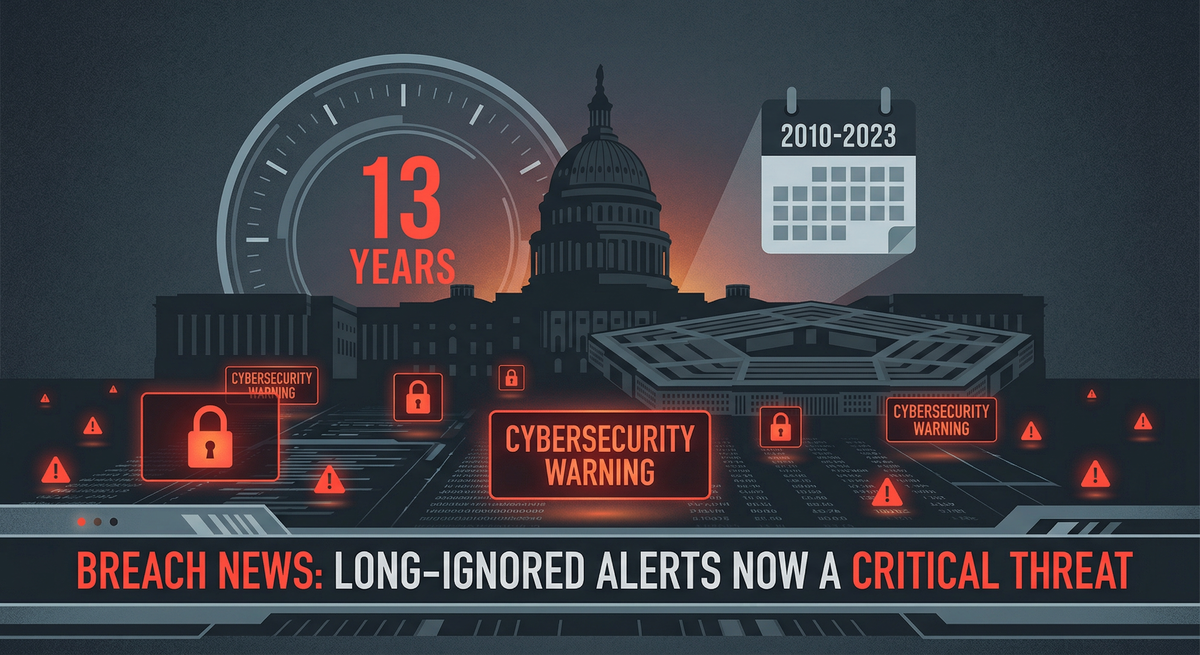
In 2012, a Defense Department inspector general report sounded the alarm: signature-based antivirus tools could only detect threats they already knew about. The Senate Armed Services Committee acknowledged the military's cybersecurity posed an impossible operational choice. Thirteen years later, that warning has become prophecy. Federal agencies across the government remain protected by the same outdated defensive approaches that Congress questioned over a decade ago, while adversaries armed with AI and constantly shifting tactics exploit the gap with devastating effect.
 Hacker Noob Tips
Executive Summary
The story of federal cybersecurity in 2026 is not one of insufficient resources, absent technology, or unforeseeable threats. It's a story of institutional failure to act on clear warnings, bureaucratic inertia that allowed known vulnerabilities to persist for over a decade, and reactive defenses that remain perpetually one step behind evolving threats.
Recent high-profile incidents—including the Chinese state-sponsored APT41's impersonation of a U.S. congressman to conduct spear-phishing against trade groups, and the compromise of Change Healthcare affecting billions of healthcare transactions—demonstrate that attackers have leapfrogged ahead while federal defenses remain anchored to approaches flagged as inadequate in 2012.
The question is no longer whether federal cybersecurity is adequate; multiple incidents have demonstrated it is not. The question is whether leadership will finally break the cycle of reactive defense or whether we'll write identical warnings in 2038 about the AI-powered threats we're ignoring today.
The 2012 Warning: A Clear Signal Ignored
The Defense Department Inspector General Report
In 2012, the Defense Department inspector general published a report that would prove prescient. Its core finding was straightforward:
Signature-based antivirus tools can only detect threats they already know about.
This seemingly obvious statement carried profound implications:
1. Zero-Day Vulnerability
Any new malware variant, any previously unseen attack technique, any threat without a known signature would bypass detection entirely.
2. Adversary Advantage
Attackers only needed to modify existing malware slightly—changing a few bytes of code—to evade signature-based detection, while defenders had to wait for signatures to be developed, distributed, and deployed.
3. Structural Disadvantage
The very architecture of federal cyber defense was designed to fail against sophisticated adversaries. Detection depended on threats being known before they could be detected—a logical impossibility for advanced attacks.
 Hacker Noob Tips
The Senate Armed Services Committee Warning
The Senate Armed Services Committee amplified these concerns, acknowledging that the military's cybersecurity system faced an "impossible choice between operational security and mission execution."
The problem went beyond detection capabilities. The signature-based systems consumed so much communications capacity that commanders in low-bandwidth environments—exactly the kind of environments where operational security matters most—had to choose between:
- Running security tools that degraded operational capability, or
- Maintaining mission capability without adequate security protection
Neither choice was acceptable for national defense operations.
The Institutional Response: Inaction
What happened to these warnings? They were acknowledged, discussed, reported—and ultimately shelved as agencies continued to rely on the same approaches the 2012 warnings identified as inadequate.
Why?
Bureaucratic Inertia
Federal procurement cycles, budget constraints, and organizational resistance to change created momentum that kept existing systems in place.
Compliance Culture
As long as agencies met existing compliance requirements (FISMA, FedRAMP, etc.), there was little institutional pressure to go beyond checkbox security.
Resource Competition
Cybersecurity competed with every other agency priority for limited budgets. Without a forcing event, security enhancements were easily deferred.
Short-Term Focus
Political leaders with 4-year time horizons prioritized visible achievements over long-term security improvements that wouldn't produce immediate results.
The "Good Enough" Fallacy
In the absence of catastrophic public failure, legacy approaches were deemed "good enough"—until they weren't.
 Hacker Noob Tips
2025: The Chickens Come Home to Roost
APT41's Congressional Impersonation Attack
In July 2025, cybersecurity reporters exposed a sophisticated attack that demonstrated exactly what the 2012 warnings predicted:
The Attack:
- Chinese state-sponsored cyber threat group APT41 conducted a spear-phishing campaign
- Attackers impersonated Rep. John Moolenaar (R-MI), Chairman of the House Select Committee on China
- Targets: Trade groups and law firms ahead of critical U.S.-China trade discussions
- Method: Posing as Moolenaar, attackers asked recipients to share feedback on a fake draft proposal
- Payload: Malware disguised as the draft proposal document
The Failure:
This attack evaded federal detection systems and successfully reached its targets.
Consider what that means: A foreign adversary impersonated a sitting U.S. congressman to conduct intelligence collection against American organizations—and federal defenses didn't catch it.
This isn't a theoretical vulnerability. It's a demonstrated failure of the signature-based approaches that federal agencies were warned about in 2012.
 Breached Company
Why APT41 Succeeded
No Known Signature
The malware was sufficiently novel that existing signature databases didn't recognize it. Exactly as predicted in 2012.
AI-Enhanced Sophistication
With AI tools, APT41 crafted phishing emails without the traditional red flags (grammar errors, suspicious formatting) that security awareness training teaches users to spot.
Trusted Identity Exploitation
By impersonating a known congressional figure, attackers exploited trust relationships that signature-based systems cannot evaluate.
Target Selection Intelligence
APT41 used AI-enhanced reconnaissance to identify optimal targets—law firms and trade groups with relevant China exposure—demonstrating attack planning sophistication beyond simple malware distribution.
Additional 2025 Incidents
The APT41 attack wasn't an isolated failure:
Change Healthcare Breach
- BlackCat/ALPHV ransomware compromised Change Healthcare
- Disrupted healthcare transactions nationwide for weeks
- Affected prescription processing, claims submissions, and payment processing
- Demonstrated supply chain risk when critical infrastructure concentrates in single vendors
SolarWinds Supply Chain Compromise (Ongoing Effects)
Legacy of the 2020 SolarWinds breach continues to affect federal agencies, demonstrating how supply chain compromises persist for years
Multiple Agency Breaches
Ongoing incidents across civilian and defense agencies demonstrate persistent adversary access despite security investments
The Modern Threat Landscape: What's Changed Since 2012
Adversary Capabilities: Then and Now
2012: Nation-State Threats
- Sophisticated attacks required nation-state resources
- Custom malware development was time-consuming and expensive
- Attribution was easier due to limited attack tools
- Attack cycles measured in months
2026: Democratized Sophistication
- AI tools enable sophisticated attacks by smaller groups
- Malware-as-a-Service provides advanced capabilities to unsophisticated attackers
- Attribution is harder as tools proliferate
- Attack cycles measured in hours
The AI Acceleration
Artificial intelligence has fundamentally transformed cyber threats:
Automated Vulnerability Discovery
- AI scans exposed systems at scale
- Generates custom exploits automatically
- Identifies attack paths humans would miss
- Operates 24/7 without fatigue
Adaptive Malware
- Machine learning enables real-time evasion
- Malware modifies behavior based on environment
- Automatically circumvents security controls
- Defeats sandbox analysis
AI-Powered Social Engineering
- Deepfake voice and video impersonation
- LLM-generated phishing at scale
- Automated conversational attacks
- Personalization based on OSINT
Automated Attack Orchestration
- AI manages complex multi-stage attacks
- Coordinates simultaneous exploitation
- Adapts to defender responses in real-time
- Scales to thousands of concurrent targets
Email: The Unchanging Gateway
Despite decades of security investment, email remains the primary entry point for adversaries:
Why Email Is Targeted:
- Universal communication mechanism
- Must remain open for public engagement
- Users expect to receive external messages
- Human judgment is the last line of defense
Why Traditional Defenses Fail:
- Signature-based scanning misses novel threats
- URL reputation can be circumvented with newly registered domains
- Attachment analysis struggles with obfuscated payloads
- Users still click on sophisticated phishing
The APT41 Lesson:
When email successfully reaches users' inboxes via official systems, recipients reasonably assume it's already been vetted. This trust—in systems using signature-based detection from 2012—enables success for attacks that evade those outdated defenses.
The Policy Failure: BOD 18-01 and Beyond
Binding Operational Directive 18-01
The 2017 Binding Operational Directive (BOD 18-01) established email security requirements for federal agencies:
Key Requirements:
- Implementation of DMARC (Domain-based Message Authentication, Reporting & Conformance)
- STARTTLS deployment for email in transit
- SPF (Sender Policy Framework) records
- DKIM (DomainKeys Identified Mail) signing
The Problem:
These requirements, while valuable, address email authentication—ensuring senders are who they claim to be—not email threat detection. They do nothing to stop:
- Novel malware without known signatures
- AI-generated phishing without obvious red flags
- Impersonation that uses legitimate-looking domains
- Attacks that clear authentication checks but carry malicious payloads
BOD 18-01's Gap:
The directive established baseline hygiene but failed to address the fundamental detection gap identified in 2012. Agencies implementing BOD 18-01 fully still cannot detect threats they haven't seen before.
The Recommended Update
Security experts recommend comprehensive BOD 18-01 revision to:
1. Require AI-Native Detection
Deploy purpose-built, AI-powered email security that analyzes:
- Behavioral patterns indicating compromise
- Language and communication style anomalies
- Contextual appropriateness of requests
- Attack pattern recognition regardless of specific signatures
2. Implement Behavioral Analysis
Move beyond signature matching to:
- User and entity behavior analytics (UEBA)
- Normal communication pattern baselines
- Anomaly detection when patterns deviate
- Integration with broader security monitoring
3. Establish Continuous Monitoring
Replace periodic compliance audits with:
- Real-time threat intelligence integration
- Continuous security posture monitoring
- Automated detection and response
- Ongoing assessment rather than point-in-time certification
4. Address AI Threats Specifically
New guidance must:
- Recognize AI-powered attacks as a distinct threat category
- Require defenses capable of detecting AI-generated content
- Establish AI security assessment requirements
- Create information sharing specifically for AI threats
The Path Forward: Beyond Reactive Defense
The Core Problem
The 2012 warning identified a fundamental architectural flaw: reactive defenses are always one step behind evolving threats.
Thirteen years later, this remains the defining problem for federal cybersecurity. Every defensive measure responds to attacks that have already occurred:
- Signature updates require seeing malware before blocking it
- Patch deployment happens after vulnerabilities are disclosed
- Security awareness training teaches recognition of yesterday's attacks
- Compliance frameworks reflect past threat landscapes
Adversaries, particularly those armed with AI, operate in the opposite direction—constantly innovating, adapting, and exploiting the gap between their attacks and defender responses.
The Required Shift: Reactive to Adaptive
Federal cybersecurity must fundamentally shift from reactive to adaptive defense:
From Signature-Based to Behavioral
- Detect anomalous behavior regardless of specific attack signature
- Establish baselines and alert on deviations
- Focus on "unusual" rather than "known bad"
- Accept that some false positives are better than missed attacks
From Point-in-Time to Continuous
- Replace annual audits with continuous monitoring
- Assess security posture in real-time
- Integrate threat intelligence dynamically
- Respond to evolving threats immediately
From Perimeter to Zero Trust
- Assume compromise and verify continuously
- Implement least privilege access universally
- Segment networks to contain breaches
- Monitor internal traffic as carefully as external
From Human-Dependent to AI-Augmented
- Deploy AI for detection at scale
- Use machine learning for pattern recognition
- Automate repetitive security tasks
- Reserve human analysis for complex decisions
Specific Recommendations
1. Revise BOD 18-01
Update the binding operational directive to:
- Require AI-powered email security beyond signature detection
- Mandate behavioral analysis capabilities
- Establish continuous monitoring requirements
- Address deepfake and AI-generated phishing specifically
Timeline: Immediate guidance update, 180-day implementation timeline
2. Embrace AI-Native Security Solutions
The Trump administration has signaled intent to advance AI adoption across government. This presents an opportunity to:
- Deploy AI for security, solving specific labor-intensive problems
- Add value without creating governance complexity
- Operationalize AI in high-impact security applications
- Demonstrate responsible AI adoption
Specific Application:
Email security is ideal for AI-native deployment:
- Clear problem definition (detect and block threats)
- High volume enabling machine learning effectiveness
- Minimal policy complexity compared to other AI applications
- Immediate, measurable security improvement
3. Adopt Multi-Layered Defense Architecture
No single control protects against sophisticated threats. Federal agencies need:
Layer 1: AI-Powered Email Security
Detect novel threats, behavioral anomalies, and AI-generated attacks
Layer 2: Security Awareness Training 2.0
Train on current threats: quishing, ClickFix, deepfakes, AI-powered social engineering
Layer 3: Multi-Factor Authentication
Universal MFA deployment, prioritizing phishing-resistant methods (FIDO2)
Layer 4: Zero Trust Architecture
Continuous verification regardless of network location
Layer 5: Endpoint Detection and Response
Advanced endpoint protection beyond signature-based antivirus
Layer 6: Network Detection and Response
Traffic analysis for lateral movement and data exfiltration
4. Create Accountability Structures
The 2012 warning was ignored because there was no accountability for inaction. Future reforms must include:
Performance Metrics:
- Agency security posture dashboards
- Time-to-patch measurements
- Phishing assessment results
- Incident frequency and severity tracking
Leadership Accountability:
- CISO responsibility for security outcomes
- Agency head accountability for security investments
- Congressional oversight with enforcement mechanisms
- IG audits with follow-through requirements
Funding Alignment:
- Security budget as percentage of IT spend
- Dedicated funding for security modernization
- Multi-year appropriations for long-term improvements
- Consequence for agencies that defer security investments
5. Future-Proof Through Architecture
The 2012 warning took 13 years to become a crisis. What warnings today will become 2039's crisis?
Quantum Computing:
- Post-quantum cryptography transition planning
- Assessment of systems vulnerable to quantum attacks
- Migration roadmap for cryptographic infrastructure
AI Attack Sophistication:
- Prepare for AI-on-AI security scenarios
- Invest in explainable AI for security decisions
- Develop AI governance frameworks before deployment
Supply Chain Concentration:
- Map dependencies on single vendors
- Establish resilience requirements for critical systems
- Create alternatives to concentrated infrastructure
Nation-State AI Capabilities:
- Anticipate adversary AI development
- Invest in defensive AI capabilities
- Plan for AI-enabled attacks at scale
The Accountability Question
Who Failed?
The 13-year gap between warning and crisis implicates multiple parties:
Defense Department Leadership (2012-2026)
Failed to act on their own inspector general's findings, allowing known vulnerabilities to persist across administrations.
Congressional Oversight
Acknowledged the problem in 2012 but failed to mandate solutions, fund modernization, or hold agencies accountable for inaction.
Federal CISOs and CIOs
Prioritized compliance over security, accepting checkbox approaches rather than demanding effective protection.
Procurement Officials
Continued renewing signature-based security contracts despite clear evidence of inadequacy.
Budget Officials
Consistently underfunded security modernization while approving spending on less critical priorities.
OMB and Federal IT Leadership
Failed to mandate security architecture changes, update outdated requirements, or create accountability mechanisms.
Private Sector Vendors
Continued selling products they knew were inadequate rather than developing effective alternatives.
Avoiding the Repeat
To prevent writing this same article in 2039 about AI threats we're ignoring today, accountability structures must change:
IG Reports Must Have Teeth
Inspector general findings should trigger mandatory remediation timelines, funding requirements, and leadership accountability.
Congressional Oversight Must Include Follow-Through
Committee hearings that identify problems must lead to legislation, funding, and ongoing monitoring—not just reports.
Agency Heads Must Be Personally Accountable
Security failures should affect performance evaluations, budget allocations, and career progression.
Contractors Must Face Consequences
Vendors whose products fail should face contract termination, exclusion from future work, and potential debarment.
Public Transparency
Security posture information should be public enough to create political pressure for improvement.
Conclusion: Will We Learn?
The 2012 warning was clear: signature-based defenses will fail against evolving threats. Thirteen years later, that prediction has been validated by incident after incident, compromise after compromise.
The question isn't whether federal cybersecurity is adequate—the APT41 congressional impersonation attack, Change Healthcare breach, and countless other incidents demonstrate it is not.
The question is whether this time will be different.
Will leadership finally make the investments needed to move beyond reactive defense? Will Congress fund security modernization and create accountability? Will agencies deploy AI-native security tools that can detect novel threats? Will the federal government finally close the gap between warning and action?
Or will we continue the cycle of ignored warnings, deferred investments, and crisis response—writing identical analyses in 2039 about how we ignored clear warnings about AI-powered threats?
The Pentagon warned us in 2012. Security researchers have been warning about AI threats since at least 2020. The warnings are clear. The technology exists. The threats are demonstrated.
The only missing element is will: the institutional will to act on clear warnings before, rather than after, catastrophic failure.
The 2012 warning gave us 13 years. We wasted them.
The AI threat is giving us perhaps 5 years before adversaries fully operationalize these capabilities. The question facing every federal leader, every congressional appropriator, every agency CISO is simple:
Will you act on the warning this time?
Or will you be explaining, a decade from now, why you didn't?
About This Analysis
This report is published by CISO Marketplace and Compliance Hub, providing federal security leaders with analysis and recommendations for improving government cybersecurity posture.
Sources:
- Defense Department Inspector General Report (2012)
- Senate Armed Services Committee
- Federal News Network
- Abnormal AI
- DHS Binding Operational Directive 18-01
- APT41 Campaign Analysis