Flickr Data Breach Exposes 35 Million Users After Third-Party Email Vendor Compromised

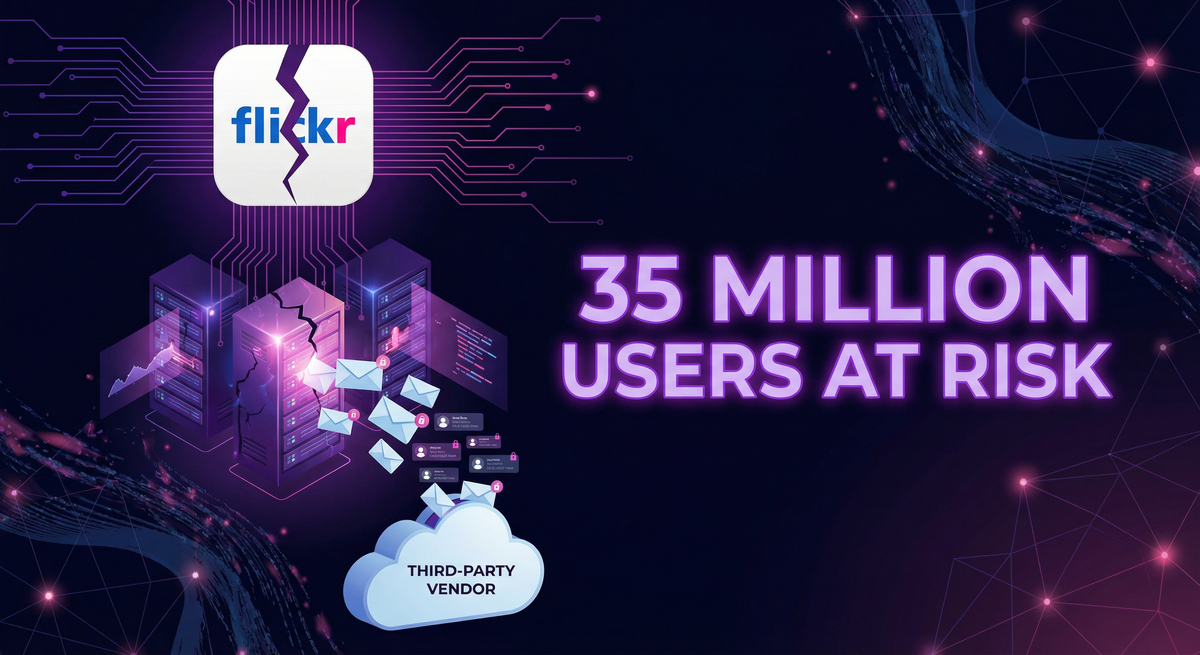
A vulnerability in an unnamed email service provider has potentially exposed the personal information of 35 million Flickr users—and the photo-sharing giant won't say which vendor is responsible.
On February 6, 2026, Flickr users around the world woke up to an unsettling email notification. The subject line was clinical, almost antiseptic: "Data Security Incident Notice." But the contents sent ripples through the security community and left millions of photographers, enthusiasts, and casual users asking uncomfortable questions about who really has access to their data.
A vulnerability in a third-party email service provider's system had potentially exposed their personal information—real names, email addresses, IP addresses, location data, and detailed activity logs. Flickr, the 22-year-old photo-sharing platform that has hosted generations of memories, had suffered its first confirmed data breach.
But here's what makes this incident particularly troubling: Flickr refuses to name the email vendor responsible.
In an age where supply chain attacks have become the preferred entry point for sophisticated threat actors, this lack of transparency isn't just a PR decision—it's a security failure that puts the entire industry at risk. Other companies using the same unnamed vendor have no way of knowing they're in danger. Security researchers can't investigate the vulnerability. And users are left to wonder whether the email provider they trust with their own data might be the same one that just exposed 35 million Flickr accounts.
Welcome to the new reality of third-party breaches, where your security is only as strong as your weakest vendor—and you might not even know who that vendor is.
The Timeline: How a Single Vendor Flaw Compromised a 22-Year Legacy
The breach unfolded with startling speed. According to Flickr's notification, the platform was "alerted" to a vulnerability in their third-party email service provider's system on February 5, 2026. The company claims it acted quickly, shutting down access to the affected system "within hours" of discovery.
February 5, 2026 — Discovery and Containment
Flickr receives notification of a security vulnerability in their email provider's infrastructure. The exact source of this alert remains unclear—whether it came from internal monitoring, an external security researcher, or the vendor itself, Flickr hasn't disclosed. The company claims to have disabled access to the compromised system and removed all links to the vulnerable endpoint within hours, though the precise window remains unspecified.
February 6, 2026 — User Notifications Begin
Less than 24 hours after containment, Flickr begins its mass notification campaign. Emails with the subject line "Data Security Incident Notice" hit inboxes across 190 countries, alerting users that their personal information "may have" been accessed by unauthorized parties. The notifications arrive before any public announcement or press release—users learn about the breach directly from Flickr, not through news reports.
Note: The legitimate notification comes from Flickr's official email addresses. If you receive similar emails from other addresses, they may be phishing attempts exploiting the breach.
February 6-7, 2026 — Public Confirmation Through User Reports
With no official blog post or press release from Flickr or parent company SmugMug, confirmation of the breach spreads through grassroots channels. Reddit threads light up as users share screenshots of their notification emails. Tech news outlets including BleepingComputer, The Register, and HackRead break the story based on user reports and the notification email text. Flickr, notably, does not respond to press inquiries.
February 7, 2026 — Regulatory Notifications Confirmed
Flickr confirms it has notified relevant data protection authorities in both the European Union and the United States. With approximately 228,000 EU users (per the platform's Digital Services Act disclosure), GDPR obligations are clearly in play.
As of Publication — No Official Public Statement
Despite widespread media coverage and user concern, Flickr has yet to issue any official blog post, press release, or social media acknowledgment of the breach. The notification emails remain the only official communication.
What Was Exposed: The Data That Makes This Breach Dangerous
Flickr's notification attempts to reassure users by emphasizing what wasn't exposed: passwords remained encrypted, payment card numbers were secure, and financial information stayed protected. These are the headlines Flickr wants users to remember.
But here's what was potentially exposed:
Confirmed Data at Risk:
- Full real names
- Email addresses
- Flickr usernames
- Account types (Pro vs. Free designations)
- IP addresses
- General location data (geographic information)
- User activity logs (platform behavior records)
On paper, this might seem like a "less severe" breach compared to incidents involving financial data or credentials. That would be a dangerous misunderstanding of what this information enables.
The Unique Dangers of Flickr Data
Flickr isn't just another social media platform. It's a photo repository that hosts over 28 billion geotagged images—photographs embedded with precise GPS coordinates revealing exactly where they were taken. Combine this with the exposed location data, IP addresses, and activity logs, and you have a detailed profile of where users live, work, travel, and spend their time.
For professional photographers, this is particularly alarming. Many Flickr users are photojournalists, wedding photographers, and documentary filmmakers whose identities are directly tied to their work. Their real names are associated with their portfolios. The combination of email addresses, location patterns, and professional identities creates a perfect targeting package for:
1. Sophisticated Phishing Campaigns
Armed with your name, email, account type, and activity patterns, attackers can craft hyper-personalized phishing emails that are nearly indistinguishable from legitimate communications. "We noticed you were uploading photos from [Location] yesterday—there's an issue with your Pro subscription..." These aren't generic Nigerian prince scams. These are surgical strikes designed to exploit specific individuals with information only Flickr should have.
2. Doxxing and Harassment
Photographers, particularly photojournalists covering sensitive topics, are frequent targets of harassment campaigns. The exposed data provides a roadmap: real names linked to usernames, location patterns revealing home addresses and travel schedules, IP addresses that can narrow geographic location even further.
3. Identity Correlation Attacks
Your Flickr username might be the same one you use on gaming platforms, forums, or cryptocurrency exchanges. Your email address definitely connects to other accounts. This data enables cross-platform identity mapping, allowing attackers to build comprehensive profiles across your entire digital footprint.
4. Social Engineering for Corporate Access
For photographers who work with media organizations, corporations, or government agencies, their compromised Flickr account becomes an entry point for larger attacks. "Hi [Name], we're reaching out about the photos you submitted to [Client]..."
The fact that Flickr emphasizes password security while downplaying these other risks suggests a fundamental misunderstanding of how modern attacks work. Credentials are just one attack vector. Identity information is the more valuable prize.
How Many Users Were Affected? Flickr Won't Say
Flickr's notification tells users their information "may have" been exposed. It's carefully hedged language designed to cover uncertainty. But it also serves to obscure a critical detail: Flickr has not disclosed how many users were actually affected.
We know the potential exposure ceiling: 35 million monthly active users across 190 countries, generating 800 million monthly page views. But did the breach touch all of them? A subset? Users in specific regions? Users of specific services? Users who received emails from particular campaigns?
Flickr isn't saying.
This matters for several reasons. First, affected users need to know they're at risk so they can take appropriate precautions. Flickr's blanket notification suggests everyone might be compromised, but if the email provider only handled certain communications, only certain users would be exposed. The vagueness creates uncertainty that breeds both unnecessary panic and dangerous complacency.
Second, the scope of the breach determines the severity of the incident under various regulatory frameworks. GDPR, CCPA, and other privacy laws have different requirements depending on how many individuals are affected and what data was exposed. By not disclosing numbers, Flickr controls the narrative in ways that may not align with user interests.
Third, without knowing the scope, the security community can't properly assess the threat. Are we looking at a targeted compromise of specific user segments, or a catastrophic exposure of the entire user base? The answer changes everything about how individuals and organizations should respond.
The Unnamed Vendor: Why Transparency Matters
The most troubling aspect of Flickr's response isn't what they disclosed—it's what they refused to reveal. The identity of the compromised email service provider remains unknown.
This is not a minor omission. It's a decision with industry-wide security implications.
Who Else Uses This Vendor?
Email service providers (ESPs) don't serve single clients. They're infrastructure companies that handle communications for dozens, hundreds, or even thousands of organizations. If Flickr's ESP was compromised through a vulnerability, other clients of that same provider may have been exposed.
By refusing to name the vendor, Flickr ensures that:
- Other companies using the same ESP have no warning
- Security teams can't check their own exposure
- The vulnerability may remain unpatched in other integrations
- The full scope of the breach across multiple organizations stays hidden
This is precisely the information-sharing failure that makes supply chain attacks so devastating. When the MOVEit file transfer vulnerability was exploited in 2023, affecting over 2,700 organizations, the rapid public disclosure of the affected product allowed security teams worldwide to check their exposure and patch their systems. The open disclosure didn't prevent all damage, but it significantly limited the blast radius.
Flickr's silence does the opposite. It protects the vendor's reputation at the expense of collective security.
The Vendor Accountability Problem
There's another dimension to this secrecy. Without naming the vendor, Flickr creates an accountability vacuum. Users can't investigate the vendor's security practices. Regulators can't examine the vendor's other clients. Security researchers can't audit the vulnerability.
The vendor, whoever they are, gets to hide behind Flickr's corporate communications shield while other organizations potentially using the same provider remain in the dark.
Was this Mailchimp? SendGrid? Campaign Monitor? Braze? Iterable? One of dozens of other enterprise email platforms? We don't know, and Flickr's refusal to say ensures we can't find out.
The Pattern of ESP Compromises
Email service providers have become high-value targets precisely because they offer scalable access to multiple client databases. A single ESP compromise can expose data from every organization using that platform.
 Breached Company
Recent history demonstrates the escalating threat:
- Substack (January 2026): Breach affecting 662,752 users exposed emails, phone numbers, and Stripe payment identifiers
- Betterment: Investment platform revealed compromise of 1.4 million email addresses via third-party provider
- Cryptocurrency platforms: Multiple exchanges compromised through ESP vulnerabilities, leading to targeted phishing campaigns and millions in wallet theft
Flickr's breach fits this pattern perfectly. And by hiding the vendor's identity, Flickr ensures the pattern will continue.
Third-Party Breaches Now Account for 35.5% of All Data Breaches
Flickr's breach isn't an anomaly. It's a symptom of a systemic problem that's reshaping the entire cybersecurity landscape.
According to SecurityScorecard's 2025 Global Third-Party Breach Report, 35.5% of all data breaches in 2024 were third-party related. That's more than one in three incidents originating not from the victim organization's own systems, but from their vendors, partners, and service providers.
The numbers reveal a disturbing pattern:
- 46.75% of third-party breaches involved technology products or services—exactly Flickr's scenario
- 41.4% of ransomware attacks now begin through third-party access, not direct compromise
- Third-party breaches grew faster than direct attacks year-over-year, signaling a fundamental shift in attacker strategy
"Threat actors are prioritizing third-party access for its scalability," explains Ryan Sherstobitoff, SVP of STRIKE Threat Research at SecurityScorecard. "Our research shows ransomware groups and state-sponsored attackers increasingly leveraging supply chains as entry points."
The logic is simple: Why spend months trying to breach a well-defended target when you can compromise their less-secure vendor and walk through the front door?
The 2024-2025 Third-Party Breach Wave
Flickr joins an unfortunate and growing cohort of major organizations compromised through their vendor relationships:
Change Healthcare (2024): Breach through third-party claims processing systems exposed personal health information for over 100 million patients—one of the largest healthcare breaches in U.S. history.
Snowflake Data Wave (2024-2025): Over 165 organizations compromised through the cloud data platform, including household names like Ticketmaster, Santander Bank, and AT&T. Total affected individuals in the hundreds of millions.
MOVEit Transfer Vulnerability (2023-2024): Exploited flaw in file transfer software affected 2,700+ organizations worldwide, including major financial institutions, government agencies, and healthcare systems.
Salesforce Integration Compromises (2024-2025): Breaches through Salesloft and Gainsight exposed hundreds of organizations' customer data, revealing how deeply interconnected modern business software has become—and how that creates cascading risk.
The Verizon 2025 Data Breach Investigations Report confirms the trend: third-party breaches jumped to 30% of all incidents, up significantly from previous years. Nearly every high-impact breach in 2024-2025 involved some form of supply chain, third-party, or vendor-access vector.
Flickr is not unique. Flickr is typical.
What Flickr Got Right—And What They Got Wrong
Credit where it's due: Flickr's response to this breach was faster and more proactive than many organizations manage.
What Flickr Did Right
Rapid Containment: Shutting down access within hours of discovery is genuinely impressive. Many organizations take days or weeks to fully contain breach conditions. Flickr's claim of same-day containment, if accurate, reflects well on their incident response capabilities.
Proactive User Notification: Rather than burying the breach in a blog post or waiting for press coverage to force their hand, Flickr sent direct emails to users. This is the right approach—affected individuals learned directly from the source, not through news reports.
Regulatory Compliance: Notifying EU and US data protection authorities promptly demonstrates awareness of legal obligations and willingness to engage with oversight bodies.
Clear Negative Disclosure: Explicitly confirming that passwords and financial data were not exposed helps users calibrate their response. This transparency about what wasn't compromised is valuable.
User Guidance: The notification included practical recommendations for users to protect themselves, including warnings about phishing attempts and suggestions to review account activity.
What Flickr Got Wrong
No Public Statement: As of this writing, Flickr has issued no official blog post, press release, or social media acknowledgment of the breach. Users who don't check their email closely might miss the notification entirely. A public statement reaches users who may have old email addresses on file or who simply overlooked the notification.
Vendor Anonymity: As discussed extensively above, refusing to name the compromised email provider limits industry learning and leaves other organizations potentially exposed.
No Victim Count: Not disclosing how many users were affected creates uncertainty and prevents accurate risk assessment.
Vague Timeline: "Within hours" is imprecise. Was it two hours? Twelve? The difference matters for understanding both the exposure window and the incident response capability.
No Technical Details: What was the vulnerability? How was it exploited? Without this information, the security community can't learn from the incident or check for similar flaws in other contexts.
Missing 2FA Recommendation: Flickr's user guidance mentions password hygiene but doesn't explicitly recommend enabling two-factor authentication. This is a notable omission given that 2FA would significantly reduce the phishing risk that Flickr itself warns about.
What Users Should Do Now: A Protection Checklist
If you're a Flickr user—whether you received a notification or not—here's what you should do to protect yourself:
Immediate Actions
1. Enable Two-Factor Authentication (Critical)
Even though Flickr claims passwords weren't exposed, enable 2FA on your account immediately. This is your single most effective defense against phishing attacks that use your exposed information to trick you into entering credentials on fake login pages. Go to Settings > Account > Two-Factor Authentication and enable it now.
2. Change Your Password—Especially If You Reuse It
If you use your Flickr password anywhere else, change it immediately on all affected accounts. Credential stuffing attacks use exposed email/password combinations to break into other services. Even without your Flickr password, attackers will attempt common passwords associated with your now-confirmed email address. Make each password unique.
3. Review Your Account Activity
Log into Flickr and check for any unrecognized changes to your profile, settings, or content. Look for new authorized applications, changed email addresses, or unfamiliar login sessions.
4. Check Your Geotagged Photos
If you've uploaded photos with embedded GPS data, consider your location privacy. Review your privacy settings to ensure sensitive location information isn't publicly visible.
Ongoing Vigilance
5. Watch for Phishing Attempts (High Risk)
The exposed data creates a perfect phishing profile. Expect a wave of targeted emails in the coming weeks and months. Be extremely skeptical of any emails referencing your Flickr account, even if they contain accurate personal details like your name, location, or recent activity—attackers now have all of that information.
Always verify by logging directly into Flickr (type the URL yourself, never click email links) or contacting support through official channels.
Red flags—Flickr will NEVER:
- Ask for your password via email
- Request login credentials through unsolicited communications
- Threaten immediate account suspension requiring urgent action
- Ask you to "verify" your account through an email link
6. Monitor for Identity Correlation
Check whether your Flickr username is used on other platforms. If so, consider whether those accounts might now be targeted. Use Have I Been Pwned to track whether your email appears in other breaches and sign up for notifications of future exposures.
7. Review Your Email Provider's Security
The breach occurred through an email vendor—reminder that your own email provider's security affects your overall exposure. Enable 2FA on your primary email account if you haven't already. Your email is the recovery mechanism for virtually every other online account.
8. Consider a Password Manager
If this breach is motivating you to improve your security hygiene, now is an excellent time to adopt a password manager. Unique passwords for every service, combined with 2FA, dramatically reduces your exposure from any single breach.
The Bigger Picture: Why Photo Platforms Are High-Value Targets
Flickr's breach illuminates a category of risk that often goes underappreciated: the unique security implications of photo-sharing platforms.
The Geotagged Data Problem
Modern smartphones embed GPS coordinates into every photo by default. Most users never change this setting. The result is that photo-sharing platforms like Flickr accumulate massive databases of location intelligence—not just where users say they live, but where they actually go, how long they stay, and what patterns emerge over time.
Flickr hosts over 28 billion images. A significant portion of these contain embedded location data. Combined with the user information exposed in this breach—names, emails, IP addresses, and activity logs—attackers gain access to detailed location profiles for millions of individuals.
This isn't hypothetical. Location data from photos has been used in:
- Stalking and harassment campaigns
- Home burglary timing (knowing when people are traveling)
- Journalism targeting (tracking photojournalists covering sensitive topics)
- Corporate espionage (identifying executive travel patterns)
- State-sponsored surveillance
The Professional Photographer Risk
Flickr's user base includes disproportionate numbers of professional and semi-professional photographers. These individuals often:
- Have verifiable public identities
- Cover sensitive topics (protests, conflicts, investigations)
- Maintain large public portfolios linked to their real names
- Travel extensively with predictable patterns
For these users, the Flickr breach isn't just a privacy inconvenience—it's a potential safety issue. The combination of identity confirmation, location patterns, and communication channels creates targeting packages that adversaries can exploit for harassment, intimidation, or worse.
The Platform Trust Problem
Users share photos they might not share anywhere else. Family photos. Home interiors. Children's faces. Vacation locations. Health journeys. The assumption of relative privacy around photo storage creates false comfort about what data is actually exposed.
The Flickr breach didn't expose the photos themselves. But it exposed enough metadata to identify who took them, where they might live, and how to reach them. That's often enough.
The Vendor Management Wake-Up Call
Flickr's breach is ultimately a story about vendor risk management—or the lack thereof.
Every modern organization relies on third-party services. Email marketing. Cloud storage. Payment processing. Customer support. Analytics. The average enterprise has relationships with hundreds of vendors, each representing a potential attack vector.
The question isn't whether to use third-party services—that ship has sailed. The question is how to manage the risk.
What Organizations Should Learn
1. Demand SOC 2 Type II Compliance
Any vendor handling personally identifiable information should have current SOC 2 Type II certification demonstrating their security controls. Type II requires actual auditing of controls over time, not just documentation of intentions.
2. Require Incident Notification SLAs
Your contracts should specify how quickly vendors must notify you of security incidents. Hours, not days. The faster you know, the faster you can respond.
3. Implement Continuous Monitoring
Annual security questionnaires aren't enough. Use security rating services to continuously monitor vendor security posture. Know when their risk profile changes.
4. Limit Data Sharing
Only share the minimum data necessary for each vendor relationship. If your email provider doesn't need location data, don't give them location data.
5. Maintain Visibility
Know exactly which vendors have access to which data. Many organizations can't even answer basic questions about their vendor data flows. This ignorance is itself a security risk.
6. Plan for Vendor Breaches
Incident response plans should include scenarios for third-party breaches. How will you contain? How will you notify? How will you communicate when the breach isn't your fault but your users are still affected?
Conclusion: The Transparency Imperative
Flickr's breach represents everything challenging—and frustrating—about modern cybersecurity. Here's a 22-year-old platform with no history of major incidents, executing a rapid containment response and proactive user notification. By many metrics, Flickr did the right things.
Yet fundamental transparency failures undermine the entire response.
By refusing to name the compromised email vendor, Flickr prioritizes short-term reputation management over collective security. Other organizations potentially using the same provider remain in the dark. Security researchers can't investigate the vulnerability. Users can't assess whether their other accounts face the same exposure. The entire industry loses the opportunity to learn and defend.
This isn't how we build a more secure digital ecosystem. This is how we ensure the next breach happens exactly the same way.
As third-party breaches continue to dominate the threat landscape—now accounting for more than a third of all incidents—the need for transparency, information sharing, and collective defense has never been greater. Every hidden vendor breach is a missed opportunity to prevent the next one.
Flickr users deserve to know who compromised their data. The security community deserves to investigate the vulnerability. Other organizations deserve the warning that their own vendors might be next.
Until companies like Flickr embrace full transparency about their security incidents—including the identities of compromised third parties—we'll continue fighting supply chain attacks with one hand tied behind our backs.
What's Next?
We'll continue monitoring this situation and update this article as new information emerges. The identity of the compromised email vendor remains the critical missing piece—if you have information about which ESP Flickr uses for transactional emails, or if you work in the email marketing industry and have insights into this incident, we want to hear from you.
For Flickr users: If you received a different version of the notification email, or if you've experienced suspicious activity following the breach, please share your experience.
For organizations: If you're re-evaluating your third-party risk management in light of this breach, our resources section includes vendor security assessment frameworks and incident response planning specifically for supply chain compromises.
The Flickr breach is a reminder that in 2026, your security perimeter extends far beyond your own walls. It reaches into every vendor relationship, every third-party integration, every service provider you trust with your data.
Choose those relationships carefully. And demand transparency when they fail.