Operation Absolute Resolve: A Deep Dive into the Cyber, OSINT, and Intelligence Operations Behind Maduro's Capture


Executive Summary
On January 3, 2026, the United States executed one of the most sophisticated multi-domain military operations in recent history, resulting in the capture of Venezuelan President Nicolás Maduro. While headlines focus on the dramatic Delta Force raid, the real story lies beneath the surface—in the months of cyber operations, signals intelligence, pattern-of-life analysis, and the unprecedented integration of U.S. Cyber Command and Space Command into kinetic military action.
This analysis examines the cybersecurity, OSINT, and intelligence tradecraft that made Operation Absolute Resolve possible, offering critical insights for security professionals about the modern convergence of cyber warfare and conventional military operations.

Timeline: From Intelligence Gathering to Execution
August 2025: CIA Ground Truth Operations Begin
The CIA covertly deployed a small team into Venezuela to establish what intelligence professionals call "pattern of life" surveillance on Maduro. This ground-truth intelligence gathering focused on:
- Movement patterns and safe house locations
- Daily routines and behavioral habits
- Security protocols and protective details
- Communications patterns and device usage
- Personal details (diet, clothing, even pets)
According to Gen. Dan Caine, Chairman of the Joint Chiefs, the team tracked "how he moved, where he lived, where he traveled, what he ate, what he wore—what were his pets." This granular intelligence formed the foundation for all subsequent operations.
September-December 2025: Multi-Domain Pressure Campaign
While CIA assets built the intelligence picture, the Trump administration executed a coordinated public and covert pressure campaign demonstrating escalating use of force:
September-December 2025:
- Dozens of strikes on suspected drug vessels in Caribbean and Eastern Pacific (115+ casualties)
- November: Venezuela crude exports peak at 900,000 barrels per day before disruption
- December 10: U.S. Coast Guard seizes sanctioned oil tanker "Skipper" - first-ever seizure of Venezuelan oil cargo
- December 13-15: PDVSA cyberattack - "massive" ransomware operation cripples administrative systems, forces 3-day terminal shutdown
- December 17: Oil loading resumes but exports remain on hold; 15 million barrels stuck on vessels
- December 19: Trump orders naval blockade of all sanctioned tankers - "thousands of troops and nearly a dozen warships" deployed to Caribbean
- Late December: CIA drone strike on Venezuelan coastal dock used by Tren de Aragua gang
- December 23: Trump's final diplomatic ultimatum call to Maduro
Strategic Effect: This graduated escalation served multiple purposes:
- Degrading Venezuela's defensive capabilities through persistent disruption
- Testing response times and capabilities of Venezuelan military and cyber defenses
- Signaling U.S. willingness to conduct direct action on Venezuelan soil
- Economic pressure - crude exports fell sharply, creating domestic political pressure
- Intelligence gathering - observing how Venezuela adapted to successive attacks
December 23, 2025: Final Diplomatic Ultimatum
Trump personally called Maduro, offering one last opportunity to leave Venezuela peacefully (with Turkey suggested as destination). Maduro refused, sealing his fate.
January 2-3, 2026: Operation Absolute Resolve
- 10:46 PM EST, January 2: Trump authorizes the operation
- 150+ aircraft launch from 20 bases across the Western Hemisphere
- 2:01 AM local time (Caracas): Delta Force reaches Maduro's compound
- Within 30 minutes: Maduro and wife Cilia Flores captured
- 3:20 AM EST: Extraction force clears Venezuelan airspace
The Cyber Operations Component: "Certain Expertise"
Trump's Cryptic Revelation
During his Mar-a-Lago press conference, President Trump made a telling comment: "It was dark, the lights of Caracas were largely turned off due to a certain expertise that we have."
This rare public acknowledgment of offensive cyber capabilities provides crucial insights into how U.S. Cyber Command operates in support of kinetic military action.
U.S. Cyber Command's Role
Gen. Caine confirmed that U.S. Cyber Command, along with Space Command, "began layering different effects" to "create a pathway" for incoming U.S. forces. While officials declined to elaborate on specific tactics, the operational objectives were clear:
- Disrupt power grid infrastructure to provide cover of darkness
- Degrade air defense detection capabilities
- Interfere with Venezuelan military communications
- Support overall operational security and surprise
Technical Attribution and Analysis
NetBlocks Internet Monitoring Data
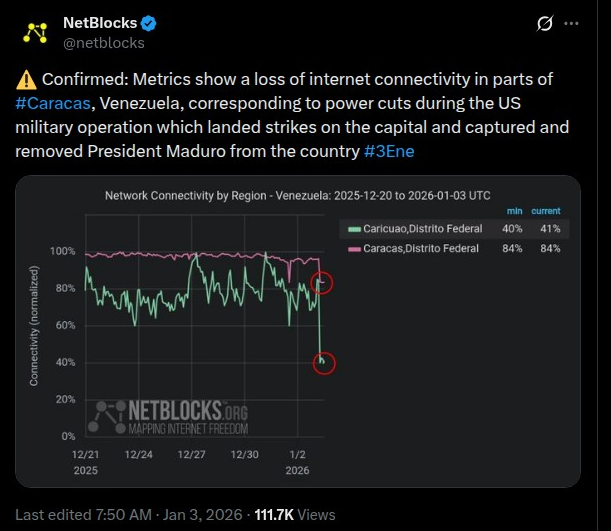
NetBlocks, an independent internet observatory, confirmed metrics showing "a loss of internet connectivity in parts of Caracas, Venezuela, corresponding to power cuts during the US military operation."
Key findings:
- Targeted, not widespread: Alp Toker, NetBlocks founder, noted the outages appeared targeted rather than affecting broader network infrastructure
- Correlation with power disruption: Internet connectivity losses directly correlated with electrical grid failures
- Timing precision: Outages coincided exactly with helicopter insertion phases
⚠️ Confirmed: Metrics show a loss of internet connectivity in parts of #Caracas, Venezuela, corresponding to power cuts during the US military operation which landed strikes on the capital and captured and removed President Maduro from the country #3Ene pic.twitter.com/jk3N3fuazy
— NetBlocks (@netblocks) January 3, 2026
Tor Network Surge
Analysis of Tor Metrics data reveals a significant spike in Venezuelan users accessing the Tor network during and after the operation—a classic indicator of citizens seeking censorship-resistant communications during political crisis and information blackouts.
Comparative Context: Ukraine Cyber-Kinetic Coordination
The Venezuela operation mirrors successful Russian tactics from Ukraine. In November 2023, Mandiant documented how Russian Sandworm hackers tripped circuit breakers at a Ukrainian power substation in coordination with missile strikes—the exact playbook U.S. Cyber Command appears to have adopted.
However, U.S. execution showed greater sophistication:
- Compressed timeline: Power disruption timed to exact minute of aircraft approach
- Surgical targeting: Avoided widespread civilian infrastructure damage
- Multi-domain integration: Cyber effects coordinated with Space Command ISR and kinetic strikes