
The Coordinated Global Push to End Online Anonymity: US, EU, UK, and Australia Build Universal Digital ID Infrastructure Under "Protect the Children" Guise

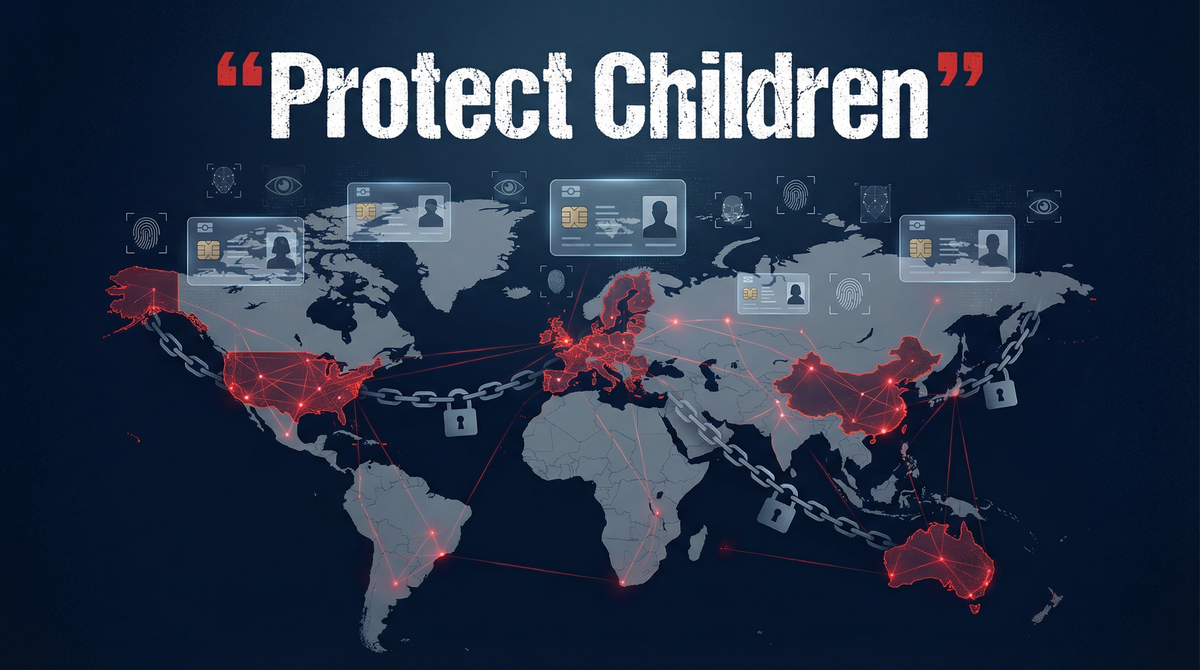
In a remarkably coordinated move across four major Western democracies, governments are dismantling online anonymity and constructing universal digital identification systems that will tie every citizen's real-world identity to their internet activity. The United States advanced the Kids Online Safety Act (KOSA) and Children's Online Privacy Protection Act (COPPA) 2.0 in December 2025, with Senate approval at 91-3 demonstrating overwhelming bipartisan support. Australia's under-16 social media ban took effect December 10, 2025, forcing platforms to verify ages through government ID or biometrics—with fines up to $49.5 million for non-compliance. The European Union is negotiating final terms of "Chat Control" legislation that would force messaging platforms to verify users and scan private communications, undermining encryption. And the United Kingdom, despite backing away from a mandatory digital ID card in January 2026, is still implementing age verification requirements that demand biometric data from all users. The justification is always the same: "protecting children." But the timing—following mass protests against Gaza genocide, climate activism, and worker organizing via encrypted apps—reveals the true target: political opposition.
 Breached Company
Executive Summary
The claim: These laws protect children from online harm, predators, and explicit content.
The reality: Governments are building infrastructure for mass surveillance and political censorship, using children as justification for systems that will monitor every adult's online activity.
The Pattern Across Four Jurisdictions:
United States
Laws Advancing (2025-2026):
- KOSA (Kids Online Safety Act): Passed Senate 91-3 (July 2024), advanced House subcommittee December 11, 2025
- COPPA 2.0: FTC approved amendments January 16, 2025, compliance deadline April 22, 2026
- GUARD Act: Introduced October 28, 2025 by Senators Hawley (R) and Blumenthal (D), would require AI chatbot age verification with 20-year prison penalties
- State Laws: 12+ states have age verification laws, Supreme Court upheld Texas law June 2025
- Visa Applicants: New rules (effective December 26, 2025) require 5 years of social media history, 10 years of email addresses, biometrics
Australia
Implemented December 10, 2025:
- Under-16 social media ban (Online Safety Amendment Act)
- Platforms: Facebook, Instagram, TikTok, X, YouTube, Reddit, Snapchat
- Fines: Up to $49.5 million for non-compliance
- Verification: Requires government ID or biometric data from ALL users (not just minors)
- Timing: Weeks after mass Gaza genocide protests on university campuses
European Union
Chat Control Legislation (Expected June 2026):
- Proposed May 2022, EU Council approved revised version November 26, 2025
- Mandatory age verification for messaging platforms
- "Voluntary" scanning of non-encrypted messages
- Signal threatens to leave EU market if forced to undermine encryption
- Trilogue negotiations began December 9, 2025
United Kingdom
Online Safety Act + Digital ID (2026):
- Government backed down on mandatory digital ID card (January 2026) after public backlash
- Still requires digital age verification for online services
- Lords introduced amendments requiring unremovable surveillance software on smartphones/tablets
- Additional amendments would ban VPN access for under-18
The Common Thread:
All four jurisdictions frame these measures as protecting children while constructing permanent systems that:
- Eliminate online anonymity (real identity required for social media, messaging, AI chatbots)
- Enable mass surveillance (government/platforms can link all online activity to real identity)
- Facilitate political censorship (once identities are known, dissent can be tracked, chilled, prosecuted)
- Create precedent for expansion (starts with "protecting children," expands to all speech)
The Context Nobody Discusses:
Since 2011, social media has enabled mass protests—Arab Spring, Occupy Wall Street, 2024 Gaza demonstrations. Encrypted messaging apps have allowed workers to coordinate strikes outside union bureaucracy control. The ruling class views these capabilities as threats to neutralize. These laws accomplish that goal while claiming to protect children.
As one analysis noted:
"The same governments imposing age verification are arming Israel's slaughter of children in Gaza, cutting funding for schools and healthcare and forcing youth into military service for imperialist wars. The claim that these measures protect children is a fraud. The target is political opposition."
United States: Bipartisan Assault on Online Anonymity
KOSA: Kids Online Safety Act
Legislative History:
- Sponsors: Marsha Blackburn (R-TN), Richard Blumenthal (D-CT)
- Senate Vote: 91-3 (July 30, 2024) - overwhelming bipartisan support
- Senate Majority Leader Chuck Schumer and Minority Whip John Thune both supported
- Reintroduced: May 14, 2025
- House Subcommittee Advancement: December 11, 2025
What KOSA Does:
- Requires platforms to verify ages of users
- Imposes "duty of care" to prevent harm to minors
- Enables state attorneys general to sue platforms
- Effectively forces age verification for all users (platforms can't know who's a minor without checking everyone)
The Surveillance Implication:
To comply with KOSA, platforms must:
- Collect government-issued ID from all users
- Perform facial recognition to match ID to user
- Store identity-to-account linkage indefinitely
- Make data available to government investigators upon request
Result: Every American's social media activity becomes permanently tied to their real identity, searchable by government agencies.
Civil Liberties Opposition:
- Electronic Frontier Foundation (EFF) opposes
- ACLU warns of First Amendment violations
- But Congress doesn't care—91-3 vote shows political will
COPPA 2.0: Children's Online Privacy Protection Act
FTC Action:
- Approved: January 16, 2025 (FTC voted unanimously 5-0)
- Effective: June 23, 2025
- Compliance Deadline: April 22, 2026
- FTC Workshop: "Age Verification Technologies" scheduled January 28, 2026
What COPPA 2.0 Adds:
- Expands from children under 13 to teens 13-16
- Prohibits targeted advertising to minors
- Requires parental consent for data collection
- Crucially: Forces platforms to determine user ages—again requiring verification
How Verification Works:
- Upload government ID (passport, driver's license)
- Biometric selfie to match photo on ID
- Third-party verification services (Yoti, Veriff, etc.) store data
- Data retained for compliance audits
Privacy Invasion:
To "protect children's privacy," COPPA 2.0 forces government ID collection and biometric data storage from all users—the opposite of privacy.
GUARD Act: 20-Year Prison Sentences for AI Chatbot Providers
Full Name: Guidelines for User Age-verification and Responsible Dialogue Act
Introduced: October 28, 2025
Sponsors: Josh Hawley (R-MO), Richard Blumenthal (D-CT), Chris Murphy (D-CT), Mark Warner (D-VA), Mark Kelly (D-AZ)
What GUARD Does:
- Forces AI chatbot providers (ChatGPT, Claude, Gemini) to verify users' ages
- Prohibits minors from accessing "AI companions" (character.ai, etc.)
- Requires chatbots to disclose non-human status
- Criminal Penalties: Up to 20 years imprisonment for violations
The Expansion:
GUARD extends age verification from social media to AI tools, establishing principle that any online service can be forced to verify identity. If chatbots today, search engines tomorrow, VPNs next week.
The Chilling Effect:
20-year prison sentences mean AI companies will over-comply—verify everyone, store data indefinitely, share with law enforcement proactively.
Supreme Court: Age Verification Is Constitutional
Case: Free Speech Coalition v. Paxton (decided June 2025)
Issue: Does Texas law requiring age verification for adult websites violate First Amendment?
Ruling: No—age verification is constitutional
Vote: 6-3 (Roberts, Thomas, Alito, Gorsuch, Kavanaugh, Barrett)
Justice Thomas (majority opinion):
"The First Amendment does not grant adults a right to anonymous access that outweighs a state's interest in protecting minors."
Dissent (Sotomayor, Kagan, Jackson):
Warned that upholding age verification creates infrastructure for broader censorship, government tracking of all online activity, chilling effects on First Amendment rights.
Impact:
With Supreme Court approval, states are enacting age verification laws rapidly:
- 12+ states have age verification requirements
- Louisiana, Texas, Missouri, Arkansas, Virginia, Utah, Mississippi, Montana, North Carolina, Indiana, Kansas, Nebraska
- More states have bills pending
Federal judges have blocked some state laws, but Supreme Court ruling provides constitutional cover.
State Law Example: Missouri (Effective November 30, 2025)
Penalty: $10,000 per day per violation
Requirements:
- Adult websites must verify age via government ID
- Social media platforms must verify ages of Missouri residents
- Data must be stored securely (but will be stored—creating breach risk)
Louisiana Federal Ruling (December 18, 2025):
A federal judge ruled Louisiana's SB 162 (age verification for social media) violates First Amendment—but this conflicts with Supreme Court ruling, setting up appeal.
Visa Applicants: 5 Years of Social Media, 10 Years of Email
Trump Administration Rules (Effective December 26, 2025):
For 42 visa-waiver countries (Europe, Japan, South Korea, Australia, etc.), applicants must now submit via ESTA Mobile:
- 5 years of social media history (all accounts, all posts)
- 10 years of email addresses used
- Phone numbers
- Biometrics: Facial data, fingerprints, DNA samples, iris images
Result: International visitors must surrender decade of digital identity to enter US.
Precedent: Once government demands this from visitors, domestic citizens are next.
Australia: The First Western Nation to Ban Social Media for Minors
The Law: Online Safety Amendment Act
Passed: Late 2024 (Labor government)
Effective: December 10, 2025
Ban: Social media use for anyone under 16
Platforms Affected:
- TikTok
- X (Twitter)
- YouTube
- Snapchat
Fines: Up to AU$78 million (~$49.5 million USD)
How It Works:
- Platforms must verify ages of ALL users (not just Australians, not just minors—everyone)
- Verification methods: Government ID, biometric facial recognition, third-party verification services
- Users who appear under 16 are blocked from accessing platform
- Platforms bear compliance burden—if a minor slips through, massive fine
The Timing: Weeks After Gaza Protests
Context:
Australia passed this law in November 2024, weeks after massive university campus protests against Israeli genocide in Gaza. Students used TikTok, Instagram, and encrypted messaging to organize demonstrations, coordinate tactics, and share footage of police brutality.
The Pattern:
- Mass youth political organizing via social media
- Government labels it "harmful" or "dangerous"
- Law passed to "protect children"
- Infrastructure built to identify and track activists
Quote from Analysis:
"The timing of this measure, following mass opposition among youth and workers to the Gaza genocide, underscores its political character."
The Verification Burden: Everyone Loses Anonymity
The Catch:
To verify that users are 16+, platforms must verify everyone's age—including adults. You can't know who needs verification without checking everyone.
Methods:
- Government ID Upload: Passport, driver's license, birth certificate
- Biometric Matching: Selfie video to match ID photo
- Third-Party Services: Yoti, Veriff, AU10TIX (companies that store biometric data)
Privacy Violation:
Every Australian adult must now prove identity to access social media—erasing decades of online pseudonymity. Every post, like, share, and comment is now traceable to real identity.
Security Risk:
Platforms and verification companies now hold massive databases of IDs + biometrics + social media accounts—prime targets for hackers, state actors, and commercial exploitation.
The Global Model: Other Countries Are Watching
Australia's law is first in Western world. If it stands, expect:
- Canada: Already considering similar legislation
- New Zealand: Close ally, likely to follow
- European countries: Pressure to match Australia's "protection"
- US states: Will cite Australia as precedent
As one commentator noted:
"Australia has become the testing ground for digital authoritarianism in the West. If they can do this without revolution, every other country will follow."
European Union: Chat Control and the Death of Encrypted Messaging
The Proposal: Child Sexual Abuse Regulation
Official Name: Regulation to Prevent and Combat Child Sexual Abuse
Common Name: "Chat Control" (because it forces platforms to control/scan chats)
First Proposed: May 2022
Current Status: Trilogue negotiations (Council + Parliament), final deal expected June 2026
The Path to Chat Control
Early 2024: European Court of Human Rights rules encrypted communications are protected
Response: EU Council suspends planned vote, rewrites proposal
November 26, 2025: EU ambassadors approve revised proposal
- Narrow margin
- Italy, Czech Republic, Poland voted against
- Netherlands abstained
- Shows contentious nature despite passage
December 9, 2025: Trilogue negotiations begin
- European Council (member states)
- European Parliament (elected MEPs)
- European Commission (executive)
Expected: Final deal by June 2026, implementation 2027
What Chat Control Does
Mandatory Age Verification:
- All messaging platforms must verify user ages
- WhatsApp, Signal, Telegram, iMessage, Facebook Messenger affected
- Verification methods: Government ID, EU Digital Identity Wallet
"Voluntary" Scanning of Non-Encrypted Messages:
- Platforms "encouraged" to scan non-encrypted content for CSAM (child sexual abuse material)
- AI systems flag suspicious content
- Human reviewers examine flagged messages
- Reports sent to law enforcement
The Encryption Threat:
Original proposals included mandatory scanning of encrypted messages—which is mathematically impossible without breaking encryption via client-side scanning.
What "Client-Side Scanning" Means:
Instead of end-to-end encryption (only sender and recipient can read), messages are scanned before encryption:
- User types message
- Device scans message for forbidden content
- If "clean," message is encrypted and sent
- Recipient decrypts and reads
Problem: This is not true end-to-end encryption. Government/platform has backdoor access at scanning stage.
Signal's Ultimatum: Leave EU Market
Meredith Whittaker, Signal President:
"If forced to choose between undermining encryption and data protection guarantees or leaving Europe, Signal would unfortunately make the decision to leave the market."
Why This Matters:
Signal is the gold standard for encrypted messaging—used by journalists, activists, whistleblowers, human rights defenders, and privacy-conscious civilians worldwide. If Signal leaves EU, those users lose secure communications.
Precedent:
If EU successfully forces age verification and message scanning:
- Other countries will demand same
- Signal may have to shut down globally
- Encrypted messaging becomes privilege of technical users (Tor, PGP) rather than mainstream tool
The Age Verification Infrastructure
EU Digital Identity Wallet:
- Proposed as central identity system for all EU services
- Would contain:
- Government-issued ID
- Biometric data (facial recognition, fingerprints)
- Digital signatures
- Payment information
- Health records
- Educational credentials
Once Linked to Messaging:
- Every WhatsApp, Telegram, Signal account tied to EU Identity Wallet
- Government can subpoena messaging provider to link messages to real identity
- Mass surveillance infrastructure complete
The Precedent: From Children to Everyone
How Expansion Works:
- Year 1: Age verification required to "protect children" from CSAM
- Year 2: Age verification expanded to prevent "misinformation" during elections
- Year 3: Content scanning expanded to detect "hate speech" and "extremism"
- Year 4: Real-name requirements for all online speech
Brazil's Aletheia System (Active Now):
- AI system continuously scans social media, blogs, news sites
- Flags "disinformation" and hate speech
- Identifies individuals for prosecution
- Already operational—shows endpoint of "protect the children" logic
Quote:
"Brazil's Aletheia system, scanning social media for prosecutable speech, shows the trajectory: from 'protecting children' to criminalizing dissent."
United Kingdom: Mandatory Surveillance Software on All Devices
The Online Safety Act
Passed: October 2023
Implementation: Phased rollout, full implementation expected 2026
Regulator: Ofcom (Office of Communications)
Roadmap: Three phases (October 2024 roadmap published)
Key Requirements:
- Age verification for pornographic websites
- Age assurance for social media platforms
- Content moderation to remove "harmful" material
- Proactive monitoring for child safety
The Digital ID U-Turn (January 2026)
Original Plan: Mandatory digital ID card for all UK residents
Public Backlash:
- MPs held emergency debate
- 3-minute speech limit imposed due to overwhelming attendance
- Concerns: Digital exclusion, data privacy, surveillance state, cost
Government Response (January 2026):
"People will still be required to verify their ID digitally, by a process still to be finished, but this could involve existing documents such as a passport."
Translation: Backed away from new mandatory physical card, but still requires digital verification using existing IDs—so surveillance infrastructure remains intact.
Age Verification Methods (Ofcom Guidance, Spring 2026)
Document Checks:
- Upload government-issued ID (passport, driver's license)
- Biometric selfie to match photo
- Used in banking KYC (Know Your Customer) systems
Reusable Digital IDs:
- Pre-verified digital credentials
- Linked to multiple accounts (social media, banking, government services)
- One verification unlocks all platforms
Email/Utility Bill Verification:
- Confirm email linked to household utilities
- Age inferred from billing history
- Less invasive but also less accurate
Bank/Mobile Provider Verification:
- Financial institutions confirm adult status
- Leverages existing KYC data
- Privacy concerns about bank-to-platform data sharing
The Problem:
Even "less invasive" methods create permanent links between real identity and online activity. Once linked, anonymity is impossible.
The Surveillance Software Amendments (December 2025)
House of Lords Amendments to Children's Wellbeing and Schools Bill:
Mandatory On-Device Surveillance:
- All smartphones and tablets sold in UK must have surveillance software
- Unremovable by users (even parents/device owners)
- Monitors all app usage, browser history, messages
- Reports to centralized database
VPN Ban for Under-18:
- Additional amendments prohibit VPN access for minors
- Prevents circumvention of age verification and content filters
- Sets precedent for broader VPN restrictions
The Endpoint:
Every device sold in UK becomes monitoring tool for government. Users cannot opt out.
Precedent:
China requires similar surveillance software on all devices in Xinjiang region. UK is normalizing same practice under "protect the children" framing.
UK Pubs and Digital IDs (2026 Implementation)
Home Office Announcement (January 2026):
"Pubgoers will be able to prove age with digital IDs in 2026."
How It Works:
- Digital ID app on smartphone
- Facial recognition to verify identity
- Present at pub entrance instead of physical ID
- Pub scans QR code, confirms age, logs entry
Data Collection:
- Government knows every pub you visit
- Timestamps, locations, frequency tracked
- Can correlate with other data (travel, purchases, social media)
Expansion:
Once normalized for pubs, expect digital ID required for:
- Concerts and events
- Public transportation
- Retail purchases (alcohol, tobacco)
- Access to government buildings
- Eventually: all public spaces
The Surveillance Infrastructure: How It All Connects
The Data Flow
Step 1: Identity Verification
- User uploads government ID + biometric selfie to third-party verifier (Yoti, Veriff, AU10TIX)
- Verifier stores ID + biometrics + facial recognition signature
- Verifier issues "age token" to platform
Step 2: Account Linking
- Platform links age token to user account
- Real identity now permanently tied to online activity
- Can be subpoenaed by government, hacked, or sold
Step 3: Activity Tracking
- Every post, like, share, comment, message recorded
- Linked to real identity via age token
- Searchable by government agencies with warrant (or without in some jurisdictions)
Step 4: Cross-Platform Correlation
- Multiple platforms use same verification service
- Verifier can correlate accounts across platforms
- Google + Facebook + TikTok + Reddit activity linked to single identity
Step 5: Government Access
- Law enforcement subpoenas verification company or platform
- Receives complete dossier: real identity + all online activity
- Used for investigations, prosecutions, or political surveillance
The Third-Party Verification Industry
Major Players:
- Yoti (UK): Facial recognition, government ID verification
- Veriff (Estonia): Identity verification for financial services, now social media
- AU10TIX (Israel): Founded by former Israeli intelligence officers
- Jumio (US): AI-powered identity verification
- Onfido (UK): Biometric verification
Business Model:
- Platforms pay per verification (~$0.50-2.00 per user)
- Store biometric data indefinitely
- Sell aggregated data to advertisers, insurers, employers
- Government contracts for bulk access
Security Risks:
- 2023: Yoti data breach exposed 850,000 users
- 2024: Veriff vulnerability allowed spoofing
- 2025: AU10TIX database hacked, biometrics leaked
Each breach means:
- Your government ID in criminal hands
- Your facial biometrics on dark web
- Your real identity linked to all online accounts
- Cannot change your face like you change a password
The Expansion Timeline
Phase 1 (Now): Protect children
- Age verification for porn sites
- Social media age verification
- Parental consent requirements
Phase 2 (2026-2027): Prevent harm
- Age verification for gaming platforms
- AI chatbot verification (GUARD Act)
- VPN verification to prevent circumvention
Phase 3 (2027-2028): Combat misinformation
- Real-name requirements for social media during elections
- Verified accounts given algorithmic boost
- Anonymous accounts flagged as "unverified"
Phase 4 (2028+): Universal digital ID
- Required for all online activity
- Tied to government services (voting, taxes, healthcare)
- Offline activities tracked (purchases, travel, public space access)
- Social credit system (China model)
This is not speculation—it's the documented path of every surveillance system:
- Emergency justification (terrorism, children, pandemic)
- Temporary measures become permanent
- Scope expands from narrow to universal
- Enforcement becomes automated and opaque
Why "Protecting Children" Is a Fraud
The Governments Don't Protect Children
The same governments imposing age verification are:
United States:
- Cutting funding for schools, school lunch programs, child healthcare
- 13.7 million children in poverty (18.4% child poverty rate)
- Forcing youth into military service (economic draft)
- Arming Israel's slaughter of children in Gaza (14,000+ killed)
Australia:
- Cutting child welfare programs
- Highest child poverty rate in OECD (15.1%)
- Detaining refugee children in offshore camps
- Supporting Israeli genocide
European Union:
- Austerity measures cutting child services
- Migrant children dying in Mediterranean crossings (EU inaction)
- Rising child poverty across member states
- Arms exports to Israel
United Kingdom:
- 4.2 million children in poverty (30% of all children)
- Cutting school meals programs
- NHS child services underfunded
- Arms sales to Saudi Arabia (Yemen child deaths)
If governments cared about children, they would:
- Fund education, healthcare, nutrition
- End child poverty
- Stop bombing children abroad
- But they don't—they build surveillance systems
The Real Target: Political Opposition
The timing tells the story:
Australia: Passed under-16 ban weeks after Gaza protests on campuses
United States: KOSA advanced December 2025 after year of campus activism
EU: Chat Control negotiations accelerated after mass strikes coordinated via encrypted apps
UK: Online Safety Act implementation following protests against cost-of-living crisis
The Pattern:
- Mass political organizing via social media and encrypted messaging
- Government labels movement "harmful" or "dangerous"
- Law passed to "protect children" or "prevent harm"
- Infrastructure used to identify, track, and suppress activists
Brazil's Aletheia AI System (Operational Now):
- Continuously scans social media for "disinformation" and hate speech
- Identifies individuals for prosecution
- Already resulted in arrests of protesters, journalists, opposition figures
- Shows endpoint: from "protecting children" to criminalizing dissent
The Supreme Court Quote That Says It All
Justice Clarence Thomas (Free Speech Coalition v. Paxton):
"The First Amendment does not grant adults a right to anonymous access that outweighs a state's interest in protecting minors."
Translation: Government interest in controlling online speech (framed as "protecting minors") outweighs individual right to anonymous political expression.
This is the precedent that enables:
- Abolition of online anonymity
- Mass surveillance
- Political censorship
- Social credit systems
All in the name of children.
What You Can Do: Resistance and Alternatives
Individual Actions
1. Use End-to-End Encrypted Messaging (While You Still Can):
- Signal: Gold standard, but may leave EU
- Threema: Swiss-based, paid app, strong privacy
- SimpleX Chat: Decentralized, no phone number required
- Session: Based on Signal protocol, no phone number, onion routing
2. Use Privacy-Focused Services:
- Email: ProtonMail, Tutanota
- Browsers: Tor Browser, Brave
- Search: DuckDuckGo, Startpage
- VPN: Mullvad, ProtonVPN (while still legal)
3. Minimize Biometric Exposure:
- Avoid facial recognition systems when possible
- Use masks in public spaces with cameras
- Opt out of biometric verification where alternative exists
- Never provide biometrics unless legally required
4. Spread Awareness:
- Share articles about surveillance infrastructure
- Explain to family/friends why "nothing to hide" argument fails
- Support organizations fighting these laws (EFF, ACLU, Privacy International)
5. Contact Legislators:
- Even if futile, create record of opposition
- Cite specific laws: KOSA, COPPA 2.0, GUARD Act
- Demand they oppose age verification requirements
Organizational Resistance
6. Support Legal Challenges:
- ACLU lawsuits against age verification laws
- EFF challenges to KOSA and COPPA 2.0
- European Digital Rights (EDRi) fighting Chat Control
7. Pressure Platforms:
- Demand platforms refuse to implement age verification
- Support Signal's threat to leave EU (shows it's possible)
- Boycott platforms that comply without legal mandate
8. Build Alternative Infrastructure:
- Support decentralized social networks (Mastodon, Bluesky, Nostr)
- Fund encrypted messaging development
- Create mesh networks for local organizing
9. Whistleblowing and Leaks:
- If you work for verification company, platform, or government agency implementing these systems—leak the details
- Public needs to know how surveillance infrastructure works
- Contact: Wikileaks, The Intercept, investigative journalists
Political Action
10. Recognize This Is Class Struggle:
"The same ruling class constructing universal digital identification is waging war abroad—invading Venezuela, arming genocide in Gaza, escalating toward conflict with Russia and China—and building a police state at home through mass deportations, attacks on the press and the gutting of constitutional protections. These are two fronts of the same war against the working class."
The Solution:
- Independent political mobilization of workers
- Demand expropriation of technology monopolies
- Socialist reorganization of digital infrastructure
- Public ownership and democratic control of online platforms
This is not about individual privacy tips—it's about systemic power.
Conclusion: The Digital Authoritarian Future Is Here
The coordinated push across the United States, European Union, United Kingdom, and Australia to abolish online anonymity and impose universal digital identification represents the most significant assault on free speech and privacy since the invention of the internet.
What we know:
- Laws are passing: KOSA, COPPA 2.0, GUARD Act (US); Online Safety Act (UK); Chat Control (EU); Under-16 ban (Australia)
- Supreme Court approved: Age verification is constitutional (Free Speech Coalition v. Paxton)
- Bipartisan support: 91-3 Senate vote for KOSA shows consensus across political spectrum
- Infrastructure is being built: Verification companies, biometric databases, identity-to-account linkage systems operational
- International coordination: Same laws, same timing, same justification across four major Western democracies
What's coming:
- 2026-2027: Age verification becomes mandatory for all social media and messaging platforms
- 2027-2028: Real-name requirements expand to combat "misinformation"
- 2028+: Universal digital ID required for all online activity
- Endpoint: Social credit system (China model) where online and offline behavior is tracked, scored, and used to control access to services, employment, travel
The justification: Protecting children
The reality: Criminalizing dissent
The precedent: Brazil's Aletheia system (scanning social media for prosecutable speech), China's social credit system (tracking all behavior), Australia's under-16 ban (eliminating anonymity)
The stakes: Once these systems are in place, they cannot be undone. Facial recognition databases cannot be "deleted." Biometric data breaches cannot be "fixed" (you can't change your face). Identity-to-account linkages become permanent digital records of all political speech.
The question: Will we accept digital authoritarianism because it's wrapped in "protecting children" rhetoric?
Or will we recognize that the same governments claiming to protect children are:
- Bombing children abroad
- Cutting child services at home
- Forcing youth into poverty
- Building surveillance states to suppress political opposition
As the analysis concluded:
"The working class cannot defend democratic rights through appeals to the courts or capitalist politicians. US federal judges have blocked some state laws on First Amendment grounds, but the Supreme Court has ruled that age verification is constitutional. The EU has overridden objections from various civil liberties organizations. More fundamentally, the defense of privacy requires a political struggle against the capitalist system."
The fight for online anonymity is the fight for free speech, political organizing, and democracy itself. If we lose this battle, we lose the ability to organize resistance to everything else.
The digital authoritarian future is not coming. It's here. The only question is whether we'll resist while we still can.