Treasury Department Terminates All Contracts with Booz Allen Hamilton Over IRS Tax Data Breach: A Reckoning for Federal Contractor Security

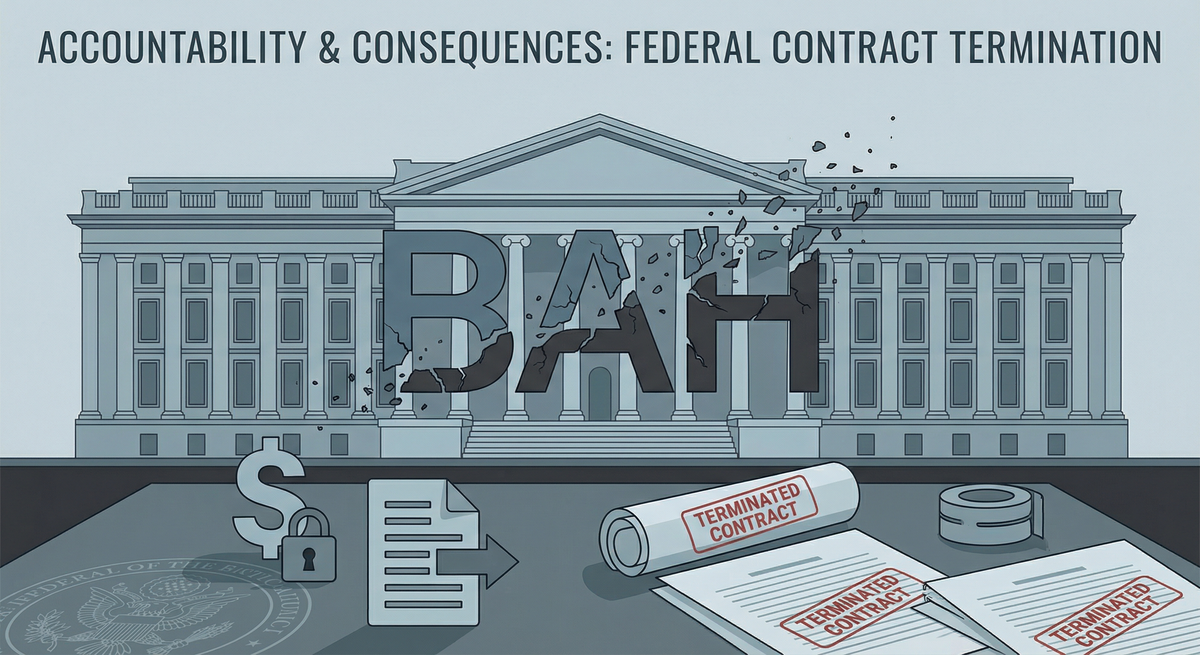
January 27, 2026 — In an unprecedented move that signals a dramatic shift in federal contractor accountability, the U.S. Treasury Department has terminated all 31 of its contracts with Booz Allen Hamilton, one of the federal government's largest consulting firms. The decision, announced by Treasury Secretary Scott Bessent, comes in response to a 2023 data breach involving the unauthorized disclosure of approximately 406,000 taxpayers' confidential tax returns—stolen by a former Booz Allen employee working as an IRS contractor.
Executive Summary
The Treasury Department's decision to cancel $21 million in total contract obligations (representing $4.8 million in annual spending) marks the most severe contractor punishment in recent federal procurement history. While Booz Allen Hamilton won $7.5 billion in federal obligations in fiscal 2025 alone, this action sends an unmistakable message: federal agencies will no longer tolerate inadequate data protection, regardless of a contractor's size or strategic importance.
The case centers on Charles Littlejohn, a former Booz Allen contractor who pleaded guilty in October 2023 to stealing and leaking thousands of confidential tax returns, including those of former President Donald Trump and numerous other high-profile individuals. Littlejohn is currently serving a five-year federal prison sentence.
The Breach: A Decade of Warnings Ignored
The Crime
Between 2018 and 2020, while working as a contractor with access to IRS systems, Charles Littlejohn systematically stole tax return information for approximately 406,000 taxpayers. The stolen data included:
- Personal tax returns of high-net-worth individuals
- Confidential return information spanning multiple tax years
- Sensitive financial data that could be used for identity theft, blackmail, or competitive intelligence
Littlejohn leaked this information to multiple news organizations, including The New York Times and ProPublica, which published stories based on the stolen data. The breach represented one of the most significant compromises of taxpayer information in IRS history.
The Systemic Failures
What makes this case particularly damning is not just the breach itself, but the systemic failures that enabled it. A class action lawsuit filed in January 2025 by Alarm Concepts and other affected taxpayers lays bare a decade of ignored warnings:
"For over a decade, the IRS and Treasury Department have known that their cybersecurity safeguards for protecting confidential taxpayer information are woefully inadequate. Federal auditors repeatedly flagged the weaknesses and recommended stronger safeguards. Yet time and again, they failed to act, leaving taxpayers' sensitive information vulnerable to unauthorized access and disclosure."
The lawsuit names three defendants:
- The Internal Revenue Service — For inadequate security controls
- The Treasury Department — For failure to enforce proper safeguards
- Booz Allen Hamilton — For "repeatedly fail[ing] to implement adequate safeguards of its own"
The case, filed in the U.S. District Court of Maryland, seeks redress for "unlawful inspections and disclosures of their confidential tax returns and return information." While the litigation hasn't moved significantly since April 2025, Treasury's decision to terminate all contracts with Booz Allen suggests the department now acknowledges the severity of the security failures.
Treasury's Justification
Secretary Bessent's statement pulls no punches:
"President Trump has entrusted his cabinet to root out waste, fraud and abuse, and canceling these contracts is an essential step to increasing Americans' trust in government. Booz Allen failed to implement adequate safeguards to protect sensitive data, including the confidential taxpayer information it had access to through its contracts with the Internal Revenue Service."
The statement notably connects the contract termination to the Trump administration's broader agenda of government efficiency and accountability—a theme that has defined the administration's approach to federal contracting since taking office.
Booz Allen's Response: Defending the Indefensible?
Booz Allen Hamilton issued a detailed response that attempts to deflect responsibility while expressing willingness to resolve the situation:
"We have consistently condemned in the strongest possible terms the actions of Charles Littlejohn, who was active with the company years ago. Booz Allen has zero tolerance for violations of the law and operates under the highest ethical and professional guidelines."
The company's defense rests on several key arguments:
1. "It Wasn't Our Systems"
"When Littlejohn's criminal conduct occurred more than five years ago, it was on government systems, not Booz Allen systems. Booz Allen stores no taxpayer data on its systems and has no ability to monitor activity on government networks."
This defense is technically accurate but misses the broader point. While Littlejohn accessed data through government systems, he did so using credentials and access granted as part of his role as a Booz Allen contractor. The question isn't whether Booz Allen's systems were compromised—it's whether the company properly vetted, monitored, and supervised its employees with access to highly sensitive government data.
2. "We Cooperated with the Investigation"
"Booz Allen fully supported the U.S. government in its investigation, and the government expressed gratitude for our assistance, which led to Littlejohn's prosecution."
Again, this is true but doesn't address the fundamental question: How did Littlejohn gain and maintain access to 406,000 tax returns over a multi-year period without any Booz Allen oversight detecting the anomaly?
3. "Let's Talk About This"
"We look forward to discussing this matter with Treasury."
The company's willingness to negotiate suggests it views the contract terminations as potentially reversible—a position that may prove overly optimistic given the current administration's approach to contractor accountability.
An Unprecedented Action
Multiple procurement experts interviewed by Federal News Network characterized Treasury's decision as extraordinary:
"It's an overreaction. Even if Booz Allen did something that was subject to suspension or debarment, no one ever gets 100% wiped out from an agency. You've seen agencies put a hold on new awards, but it's unusual to do this with a broad brush stroke."
— Former federal acquisition executive (anonymous)
Typically, when an agency identifies contract issues, the process follows established protocols:
- Stop Work Order — Temporarily halt contract work
- Investigation — Conduct a thorough review of the alleged violations
- Show Cause — Give the contractor an opportunity to explain and remediate
- Remediation or Termination — Make a final decision based on findings
Treasury appears to have skipped most of these steps, moving directly to termination for all contracts—even those unrelated to IRS operations or tax data.
Historical Precedent: The 2012 Air Force Suspension
The last comparable action occurred in February 2012, when the Air Force suspended Booz Allen's San Antonio office after allegations emerged of sharing sensitive procurement data in violation of acquisition regulations. However, that suspension was:
- Geographically limited (one office, not company-wide)
- Temporary (lifted by April after investigation)
- Specific (related to active procurement violations)
By contrast, Treasury's action:
- Agency-wide (all Treasury contracts, regardless of division)
- Permanent (no stated path to reversal)
- Retrospective (based on a crime committed years ago for which the perpetrator is already in prison)
The Broader Context: War on Consulting Contractors
Treasury's action doesn't occur in a vacuum. The Trump administration has made reducing reliance on consulting contractors a cornerstone of its government efficiency initiative.
February 2025: GSA's Top 10 Hit List
In February 2025, the General Services Administration identified ten major consulting firms for contract reduction, including Booz Allen Hamilton. By May 2025, GSA reported:
- 2,800+ consulting contract terminations
- $23.2 billion in ceiling value reductions
- $10 billion claimed in savings
June 2025: The Federal CIO's Boycott
Federal Chief Information Officer Greg Barbaccia announced that his office would no longer meet with "research, advisory and strategy consulting firms," encouraging other agency CIOs to adopt the same approach. The message was clear: "We want problem solvers, not problem describers."
May 2025: Pentagon Crackdown
Defense Secretary Pete Hegseth ordered DoD leadership not to execute new IT consulting or management services contracts unless they could first demonstrate that:
- The work cannot be performed in-house
- The work cannot be acquired directly from a service provider
- An integrator or consultant is genuinely necessary
Q3 2026: The Financial Impact
Booz Allen's January 23, 2026 earnings call revealed the impact of this policy shift:
- Revenue down 10.2% year-over-year
- 15% reduction attributed to the 43-day government shutdown
- 35% reduction from the federal government's slower funding environment
- Declining headcount and billable expenses
The company brought in $2.6 billion in revenue for Q3 2026—impressive by any measure, but trending downward.
What This Means for Federal Contracting
Immediate Implications
1. Heightened Scrutiny on Data Security
Every federal contractor with access to sensitive data should expect increased oversight, more stringent security requirements, and potential liability for employee misconduct—even if it occurs on government systems.
2. Personal Liability Questions
If companies can be held accountable for employee actions on government systems they don't control, what are the legal boundaries of contractor responsibility? This case may establish new precedents.
3. Zero-Tolerance Environment
The Treasury action signals that even full cooperation with investigations and successful prosecution of wrongdoers won't necessarily protect a contractor from severe consequences.
4. Size No Longer Provides Immunity
Booz Allen Hamilton is among the largest federal contractors. If Treasury will terminate contracts with them, no contractor is "too big to fail."
Long-Term Ramifications
Contractor Market Consolidation or Fragmentation?
This action could drive two opposite outcomes:
- Consolidation: Smaller contractors lack resources for enterprise security, driving business to fewer, larger firms
- Fragmentation: Agencies distribute risk across more contractors to avoid single-point-of-failure scenarios
Insurance Market Disruption
Cyber liability insurance for federal contractors will likely see:
- Higher premiums reflecting increased risk
- More exclusions for employee misconduct
- Additional security requirements as policy conditions
Compliance Costs Skyrocket
Contractors will need to invest heavily in:
- Employee monitoring systems (raising privacy concerns)
- Continuous security audits beyond standard compliance requirements
- Enhanced background checks and insider threat programs
- Segregation of duties to prevent single-person data access
Talent Acquisition Challenges
Heightened security requirements and monitoring may make contractor positions less attractive, particularly to privacy-conscious technical talent.
The Systemic Problem Treasury's Action Exposes
While Treasury focuses its ire on Booz Allen, the lawsuit and historical record reveal a more complex reality: the government itself failed to implement adequate security controls despite a decade of warnings.
The Government's Role
The class action lawsuit explicitly states:
"Federal auditors repeatedly flagged the weaknesses and recommended stronger safeguards. Yet time and again, they failed to act."
Questions Treasury must answer:
- Why did IRS systems allow a single contractor to access 406,000 tax returns?
- What automated monitoring could have detected this pattern of anomalous access?
- Why weren't contractor actions on government systems subject to real-time auditing?
- What has changed in IRS security architecture since 2020 to prevent recurrence?
The Accountability Gap
Littlejohn is in prison. Booz Allen has lost Treasury contracts. But which IRS security officials have been held accountable? Which Treasury supervisors faced consequences for ignoring federal auditor recommendations?
Without accountability for government failures, terminating contractor relationships merely shifts blame rather than addressing root causes.
What Organizations Should Learn
For Federal Contractors
1. Assume You're Responsible for Employee Actions—Everywhere
Even if misconduct occurs on government systems you don't control, expect to be held accountable. Implement:
- Continuous monitoring of employee behavior patterns
- Automated anomaly detection for data access
- Regular security awareness training with testing
- Incident response plans that assume employee insider threats
2. Document Everything
Booz Allen's defense relied on proving cooperation and lack of system access. Comprehensive documentation of:
- Security controls implemented
- Employee monitoring procedures
- Government coordination
- Audit trail of all security decisions
3. Insider Threat Programs Are Non-Negotiable
The Littlejohn case exemplifies the insider threat. Contractors need:
- Behavioral analysis to detect anomalous actions
- Privilege escalation monitoring
- Data loss prevention on all systems
- Regular psychological evaluations for high-risk positions (where legally permissible)
4. Consider Insurance Implications
Review cyber liability policies to ensure:
- Employee misconduct coverage
- Government contract termination protection
- Class action lawsuit defense
- Reputation damage provisions
For Federal Agencies
1. Own Your Security
Don't rely on contractors to implement security for your systems. Government must:
- Deploy continuous monitoring on all systems with sensitive data
- Implement zero-trust architecture
- Audit contractor access in real-time
- Automate anomaly detection
2. Background Checks Aren't Enough
Littlejohn had all necessary clearances. Background checks verify past behavior, not future intentions. Implement:
- Continuous evaluation of cleared personnel
- Behavioral indicators programs
- Anonymous reporting mechanisms
- Regular privilege re-validation
3. Segment Access
No single person should be able to access 406,000 tax returns without triggering multiple alerts. Design systems with:
- Least privilege access
- Just-in-time elevation
- Break-glass procedures with extensive logging
- Dual-person integrity for sensitive operations
Political Dimensions
The timing and framing of Treasury's announcement aren't accidental. Secretary Bessent explicitly connected the decision to "President Trump's" agenda to "root out waste, fraud and abuse."
The Trump Tax Returns Factor
Among the data Littlejohn stole and leaked were former President Trump's tax returns—information Democrats had sought for years through legal channels. While Littlejohn's stated motivation was public interest, the breach became politically charged.
By terminating contracts with Booz Allen over this breach, the Trump administration:
- Demonstrates accountability for an incident that affected the President personally
- Signals seriousness about federal contractor security
- Aligns with campaign promises to reduce government waste
- Appeals to base concerns about the "deep state" and contractor accountability
What Happens Next?
Likely Scenarios
1. Behind-the-Scenes Negotiation
Procurement experts expect Booz Allen and Treasury to negotiate a resolution that allows the company to "save face" while acknowledging security shortcomings. This might include:
- Enhanced security protocols for any future contracts
- Independent security audits at Booz Allen expense
- Financial penalties or voluntary contract value reductions
- Phased reinstatement of non-sensitive contracts
2. Legal Challenge
If negotiations fail, Booz Allen could challenge the terminations in federal court, arguing:
- Lack of due process in the termination decision
- Disproportionate punishment given cooperation and remediation
- Selective enforcement if other contractors with security incidents faced lesser consequences
3. Congressional Oversight
Expect House and Senate hearings on:
- IRS security failures that enabled the breach
- Contractor oversight and responsibility boundaries
- Treasury's termination process and whether it followed proper procedures
- Systemic reforms needed across federal contracting
4. Industry-Wide Security Review
Other agencies may launch reviews of their own contractor security arrangements, particularly for:
- Intelligence community contractors
- Law enforcement data processors
- Healthcare information handlers (e.g., CMS contractors)
- Financial services providers
Recommendations
For Treasury Department
1. Explain the Standard
Publish clear guidelines on contractor security expectations so other vendors understand what's required to maintain Treasury contracts.
2. Fix Your Own House First
Demonstrate that IRS has implemented the security controls that federal auditors recommended for over a decade.
3. Establish a Path to Reinstatement
If Booz Allen can demonstrate adequate security improvements, outline what's required for contract eligibility restoration.
For Booz Allen Hamilton
1. Accept Responsibility
Stop deflecting to "government systems." While technically accurate, it sounds tone-deaf. Acknowledge that your employee abused trust on your watch.
2. Demonstrate Concrete Improvements
Publish a detailed security remediation plan showing:
- What controls existed in 2018-2020
- What gaps allowed Littlejohn's actions
- What you've implemented since
- How you'll monitor going forward
3. Make Stakeholders Whole
Consider a compensation fund for affected taxpayers, beyond whatever the class action lawsuit might ultimately award.
For Federal Contractor Community
1. Don't Wait for Your Agency to Act
Assume you'll be held to Treasury's standard. Implement security improvements now.
2. Advocate for Clarity
Work through industry associations to push for clear, consistent security standards across agencies.
3. Share Best Practices
Collaborate on insider threat programs, monitoring approaches, and security innovations. The contractor community's reputation depends on all members maintaining high standards.
For Congress
1. Legislate Contractor Security Standards
Establish clear, enforceable security requirements for federal contractors handling sensitive data.
2. Hold Government Accountable
Don't let agencies scapegoat contractors for government security failures. Investigate IRS and Treasury inaction on federal auditor recommendations.
3. Fund Security Improvements
Acknowledge that implementing enhanced security costs money. Provide appropriations for agencies to modernize their systems and oversight.
Conclusion: A Watershed Moment
The Treasury Department's termination of all Booz Allen Hamilton contracts represents more than punishment for a specific breach—it's a watershed moment in federal contractor accountability.
For years, the relationship between federal agencies and their large consulting contractors operated with an implicit understanding: contractors provided critical expertise and capacity, agencies provided steady revenue streams, and both parties shared responsibility for security and performance outcomes proportionally.
That implicit agreement has been torn up.
Treasury's action establishes a new precedent: contractors can be held fully responsible for employee misconduct, even when that misconduct occurs on government systems the contractor doesn't control, and even when the contractor cooperates fully with investigations and prosecutions.
Whether this represents justice or scapegoating depends on your perspective. Taxpayers whose confidential information was exposed might argue Booz Allen should bear consequences for failing to prevent a trusted employee's betrayal. Contractor executives might counter that they can't be expected to monitor employee behavior on government networks they don't operate.
What's indisputable is that the federal contracting landscape has fundamentally changed. The question facing every federal contractor is no longer "How do we comply with security requirements?" but rather "How do we prevent every possible employee from even considering misconduct?"
That's a far higher—and perhaps impossible—standard. But in the wake of Treasury's decision, it's the standard to which contractors will be held.
About This Analysis
This report is published by CISO Marketplace and Breached.Company, providing security and procurement professionals with in-depth analysis of significant cybersecurity incidents and their implications.
Sources:
- U.S. Treasury Department Press Releases
- Federal News Network
- U.S. District Court of Maryland (Alarm Concepts v. IRS, et al.)
- U.S. Department of Justice
- Booz Allen Hamilton Public Statements
- USASpending.gov
- Deltek Federal Procurement Data